Heating-method guide

Direct vs Indirect UHT Processing

Choose a UHT heating route from the product, quality target, utilities, recovery plan, cleanability, sterile boundary, and documented acceptance criteria—not from one generic claim about temperature or speed.

Confirm that the proposed direct or indirect system is supported by project-specific documents covering the formula, output, heat history, product losses, utilities, and validated line boundary.

Last updated .

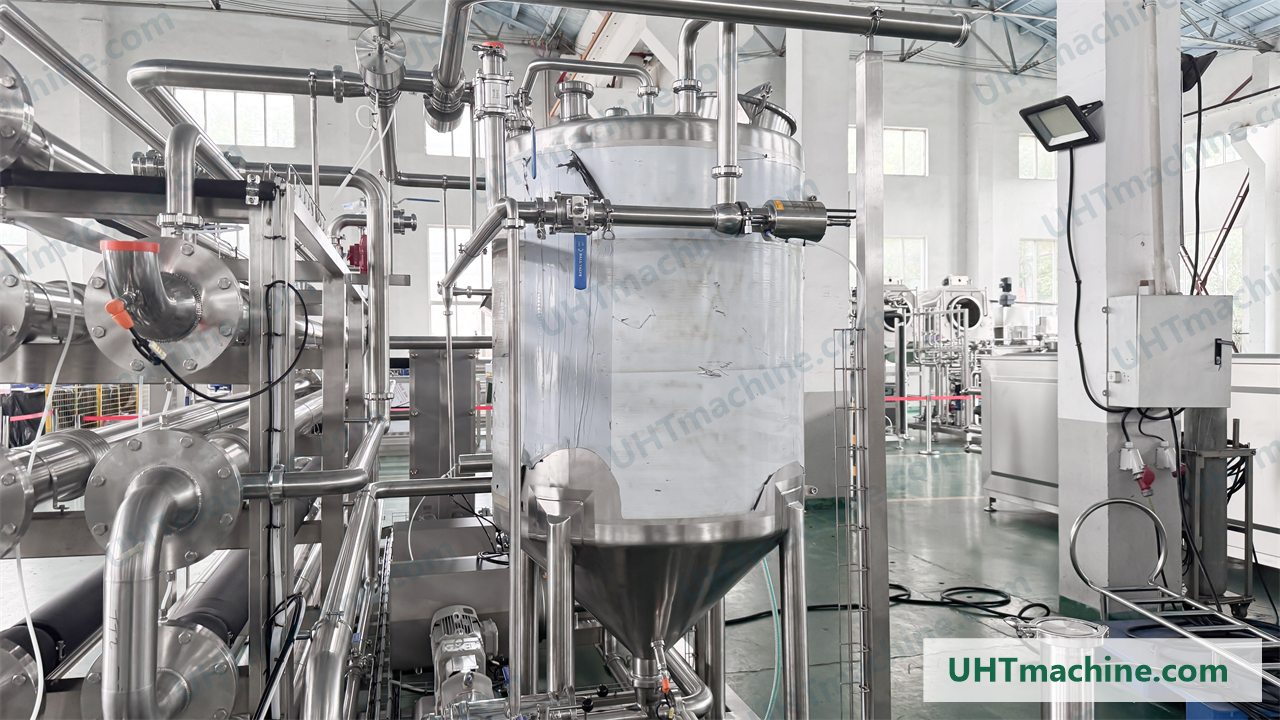
Stainless steel liquid-processing line used as a UHT system reference
System reference image only; it does not identify a direct or indirect design. Verify the final process, equipment, and delivery scope.

Technical overview

Where does heat enter the product?

Indirect UHT

A heat-transfer surface separates the product from the heating and cooling media. Plate, tubular, or other exchanger geometry is selected around viscosity, particles, pressure, fouling, cleaning, and required regeneration. Buyers should compare the complete exchanger train and operating envelope, not only the named format.

Direct UHT

Approved culinary steam contacts the product to raise temperature rapidly, followed by controlled flash cooling that removes water added by steam condensation. The proposal must define steam quality, mixing, vacuum, condensate handling, product balance, aroma effects, and the downstream sterile boundary.

Neither route is automatically superior

The useful choice depends on the actual formula and acceptance target. Heat sensitivity, volatile flavor, dissolved gas, viscosity, particles, fouling, production rhythm, utilities, product losses, cleaning, operator capability, and validation responsibility all change the comparison.

Decision matrix

Compare direct and indirect UHT on one process basis

Require every bidder to use the same product data, inlet condition, output basis, package interface, operating schedule, utility assumptions, and acceptance method.

Product contactIndirect systems separate product and heating medium with a heat-transfer surface. Direct systems require controlled contact with approved culinary steam plus documented removal of condensed water.
Thermal historyCompare measured heating, holding, cooling, diversion, startup, and shutdown behavior for the real formula. Do not infer product quality from a heating-method label alone.
Product fitProvide viscosity over temperature, particles, fibers, protein or starch behavior, acidity, dissolved gas, heat sensitivity, aroma target, fouling history, and trial evidence where available.
Energy and waterNormalize regeneration, steam, cooling water, chilled water, vacuum demand, startup time, cleaning time, and production schedule. Ask for the calculation basis and operating conditions behind each estimate.
Yield and lossesDefine startup displacement, diversion, shutdown recovery, flash-vessel balance, hold-up volume, product-water interfaces, cleaning transitions, and how saleable output will be measured.
Hygiene and validationMap CIP and sterile boundaries, culinary-steam controls, filters, vacuum system, condensate, valves, instruments, aseptic tank or filler interface, process authority, records, and change control.

Direct-heating detail

Separate steam injection from steam infusion in the quotation

Both are direct UHT routes, but the contact arrangement and supplier design differ. Steam injection introduces steam into the product stream. Steam infusion distributes product into a steam environment. Ask the supplier to document mixing, residence-time distribution, pressure control, flash cooling, aroma recovery or loss, fouling locations, product recovery, cleaning, and proof from a relevant trial.

RFQ inputs

Information needed before a defensible recommendation

Buyer questions

Questions to resolve before choosing the heating route

What is the main difference between direct and indirect UHT processing?

Direct UHT brings approved culinary steam into contact with the product and then removes added water by controlled flash cooling. Indirect UHT transfers heat across a surface, so the heating medium does not contact the product.

How do steam injection and steam infusion differ?

Steam injection introduces steam into a flowing product stream, while steam infusion distributes product into a steam environment. Buyers should compare the supplier's mixing, residence-time, vacuum, condensate, control, and cleanability evidence for the proposed design.

Is direct UHT always better for product quality?

No. Product quality depends on the formula, validated time-temperature history, mixing, fouling, oxygen, homogenization, cooling, packaging, and operating control. A product trial and agreed acceptance plan are safer than a general claim.

What should a direct-versus-indirect quotation comparison include?

Use one process basis and compare product limits, guaranteed output, heat recovery, steam and cooling demand, product loss, culinary-steam and vacuum scope, CIP and sterile boundaries, controls, FAT, validation support, and exclusions.