Plant-based beverage guide

UHT Machine Selection for Plant-Based Drinks

Select the UHT route from the actual formulation, particle and viscosity behavior, heat stability, homogenization need, cleaning burden, and package—not from the ingredient name alone.

The final thermal process, shelf-life target, and sterile release criteria must be established and validated for the product, equipment, package, and destination market.

Last updated .

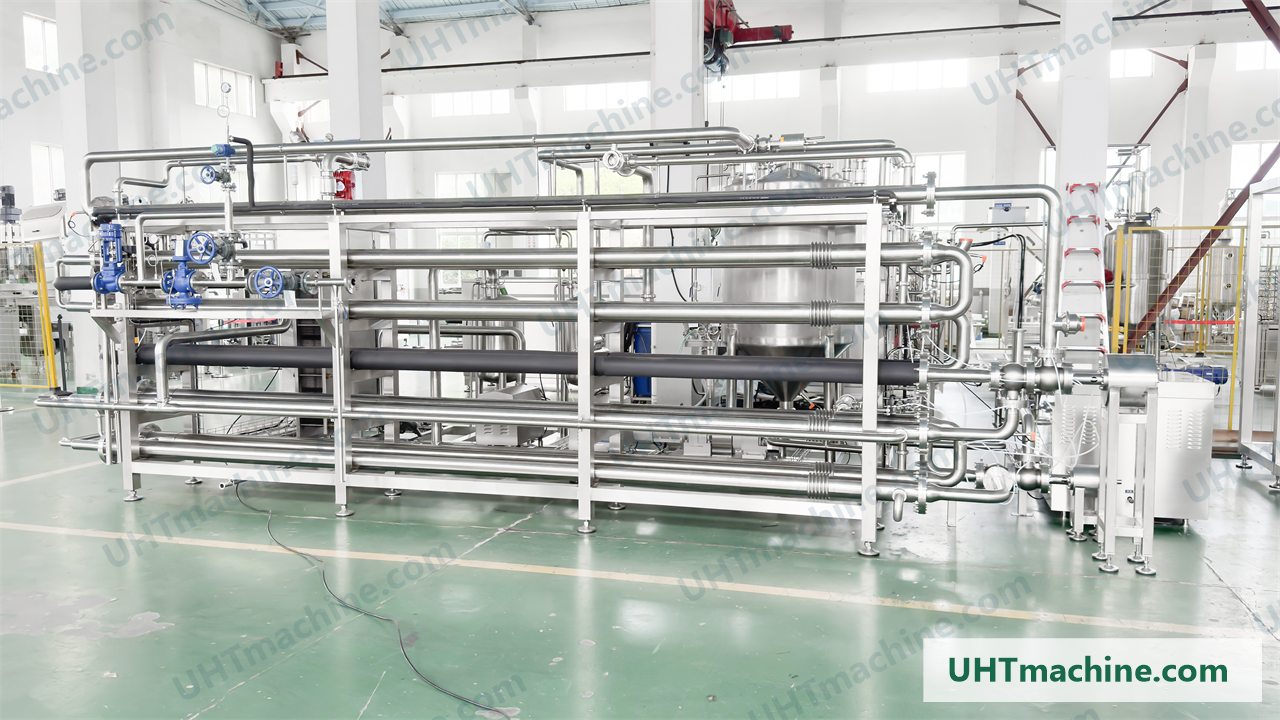
Tube-in-tube UHT equipment considered for viscous plant-based beverage duties
Equipment reference for flow-path discussion; the image does not identify the product being processed or prove suitability for a specific formula.

Product characteristics

Start with the finished beverage, not only the plant source

Formula behavior

Record the base material, protein, starch, oil, minerals, stabilizers, total solids, pH, suspended particles, and viscosity across the expected process temperatures. Oat, soy, almond, pea, rice, and coconut formulations should not be treated as interchangeable duties.

Quality risk

Define the acceptable flavor, color, separation, sediment, and particle outcome. Heat stability and product quality can change with extraction, enzyme treatment, hydration, mixing, deaeration, and homogenization before the UHT module.

Line boundary

Mark which preparation, separation, filtration, homogenization, sterile buffering, filling, utilities, and cleaning systems are included. A machine quote is not a complete line unless every interface and exclusion is explicit.

Engineering comparison

Compare the heating route against product and cleaning evidence

A useful proposal connects formula data to heat-transfer geometry, residence-time behavior, pressure drop, fouling margin, cleaning strategy, and the downstream sterile boundary.

Indirect plateMay be evaluated for suitable low-viscosity, low-particle duties where compact heat recovery is important. Require a documented operating envelope rather than assuming all plant drinks fit a plate unit.
Indirect tubularMay provide a more tolerant flow path for formulas with higher solids, changing viscosity, or greater fouling concern. Confirm tube geometry, velocity range, pressure drop, and cleaning evidence for the actual formulation.
Tube-in-tubeCan be compared when viscosity or suspended material makes the flow path a dominant selection factor. Pumping, shear, product recovery, and hold-up still require project-specific review.
Direct heatingSteam injection or infusion may reduce product heat exposure, but culinary-steam quality, dilution, flash vacuum, aroma effects, utilities, aseptic design, and cleaning scope must be evaluated together. Compare direct and indirect UHT.
Trial evidenceUse controlled trials to compare stability, sensory change, fouling, run length, cleaning response, and sample handling. Plan pilot plant-based trials before freezing production equipment.

Complete process

Map preparation, homogenization, UHT, and filling as one line

This planning sequence is not a validated process recipe. Optional modules and responsibility boundaries must be selected for the actual product.

  1. 01Prepare and standardize

    Define extraction, separation, enzyme treatment, blending, hydration, filtration, and a stable feed condition.

  2. 02Deaerate or condition where required

    Evaluate dissolved gas, foam, aroma, oxidation, and feed-temperature effects.

  3. 03Place homogenization deliberately

    Freeze upstream or aseptic downstream position, inlet condition, bypass, controls, and sterile responsibility without assuming one universal pressure.

  4. 04Heat, hold, and cool

    Define the selected heat route, verified flow range, holding section, instrumentation, diversion, and sterile cooling boundary.

  5. 05Buffer and fill aseptically

    Match UHT output to the aseptic tank or filler, package, planned stops, control handshakes, and recovery sequence.

  6. 06Clean and change products

    Separate production from CIP and sterile preparation; assign protein, starch, mineral, and allergen-changeover evidence to agreed circuits.

RFQ checklist

Plant-based drink data to send before quotation

Buyer questions

Plant-based UHT questions to resolve before equipment selection

What UHT machine is best for plant-based drinks?

No single configuration is best for every plant-based beverage. Compare the heating route, flow path, homogenization interface, fouling margin, cleaning plan, and aseptic filling boundary against the actual formula and trial evidence.

Can one UHT line process oat, soy, almond, and pea drinks?

A multi-product line may be possible only when the supplier documents the operating envelope, changeover sequence, cleaning boundary, controls, and performance limits for every agreed product family.

Do plant-based drinks need homogenization?

Homogenization is often considered for dispersion and stability, but the required position and operating conditions depend on the formulation, process route, package, and validated quality target.

What information is needed for a plant-based UHT quote?

Provide ingredients and solids, viscosity over the relevant temperature range, particles, pH, heat sensitivity, homogenization needs, target output, package, utilities, cleaning constraints, and available pilot data.